
When traditional savings yields are stuck near zero and clients are wary of market risk, Indexed Universal Life offers a middle path: growth tied to an index, with a floor that keeps a bad year from becoming a bad decade.
Key takeaways
- IUL’s 0% floor means a bad market year doesn’t reduce the policy’s value, unlike a directly-invested account.
- Upside is capped — often as high as 13% — but that tradeoff is what funds the downside protection.
- IUL fits college savings, key employee retention, and executive compensation cases where clients want growth without full market exposure.
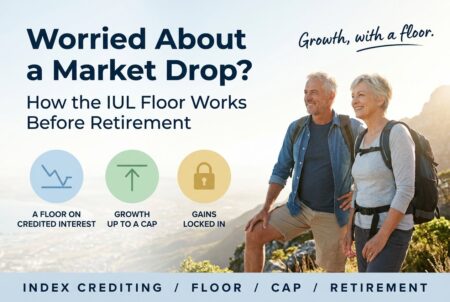
If an index drops 20% in a given year, an Indexed Universal Life policy with a 0% floor doesn’t lose value — while a gain can be credited up to a cap as high as 13%.
How the downside protection actually works
Indexed Universal Life carries a 0% floor: if the index drops 20% in a given year, the policy’s value isn’t reduced by that loss. When the index is up, the client realizes a gain credited up to an interest rate cap, which can run as high as 13% depending on the carrier and product.
Which indices clients can choose from
Most IUL products are tied to the S&P 500, though some carriers also offer the Hang Seng and EURO STOXX 50 as additional index options within that carrier’s lineup.
Who this fits best
Prospects building a college savings account, retaining a key employee, or compensating a high-level executive are all strong fits — anyone who wants long-term accumulation without full exposure to market volatility.
Frequently asked questions
Can the policy actually lose value if the index drops?
No — the 0% floor means a negative index year doesn’t reduce the policy’s value, though cost of insurance and fees still apply regardless of index performance.
Is the participation rate the same as the interest rate cap?
No. The cap limits the maximum credited rate; the participation rate determines what percentage of the index’s gain counts toward that credit. Both vary by carrier and index.
Reviewed by Tim Fuller on 2026-09-25

Tim Fuller
President, SRS Inc.
Tim leads SRS Inc., a full-service IMO (Independent Marketing Organization) and BGA (Brokerage General Agency), connecting independent financial professionals with life, annuity, disability income, and long-term care solutions from 60+ carrier partners.
Connect on LinkedIn →We’re Here to Help
Have a question about what you just read, or a case you’re working on? Tell us a bit about what you need, and a member of the SRS team will follow up with you personally — no obligation, no hassle.